Now in its seventh year, the First Advantage Global Trends Report continues to be a vital hiring and compliance resource for organisations worldwide. Our report comprises business trends around the globe. It identifies the background screening elements most important to customers, while also highlighting key takeaways you can use to help guide your future background check strategies.
Now let’s explore several foundational themes, including innovative strategies many successful businesses are using to transform their candidate experiences and increase their background check efficiency.
For a deeper dive, download the full report.
5 Key Insights from Our 2025 Global Trends Report
As an employer, you want to be well-informed and confident in your hiring decisions. From rescreening to digital identity and more, this year’s trends report discusses the evolving screening landscape and what you should be aware of to remain efficient and competitive.
Discover more as we delve into five key areas shaping employment background checks today:
- Managing Hiring Risk and Regulatory Compliance Are Top Screening Priorities
Unlike the North America and Asia Pacific regions, the Europe, Middle East, and Africa (EMEA) region has shown notable consistency in the factors customers prioritise in background checks. Managing hiring risk has remained the top priority in EMEA for the past two years, in contrast to NORAM and APAC, where speed has recently overtaken cost and risk as the most critical screening factor.
Advances in automation technology are driving this change, enabling faster turnaround times that help companies achieve four main objectives:
- Recruit more effectively in competitive markets
- Enhance the candidate experience
- Onboard talent faster
- Maintain compliance with applicable laws
When we asked our customers to rank the reasons why they conduct background screens, regulatory compliance emerged as the clear winner, surpassing brand protection, evaluating future risks, and ensuring candidate job qualifications.
This shift underscores the increasing importance for organisations to adhere to ever-changing regulatory standards in background screening. Partnering with a trusted screening provider can help them to do so.
Key takeaway: Managing hiring risk in background screening whilst maintaining regulatory compliance is a top priority for customers in EMEA. However, it’s essential to balance risk with speed and cost. For instance, faster searches may reduce time and cost but could increase hiring risks if the screening scope is too narrow. Organisations should align their screening programs with relevant factors.
- What Matters Most?
In the Europe, Middle East, and Africa (EMEA) region, we asked organisations about their main reason for conducting background screening. 59% of survey respondents said that regulatory compliance is their top priority, followed by ensuring job qualifications, cited by 18% of respondents.
Focusing on Europe and UK, where hiring trends vary across countries, recent data from Indeed highlights a mixed landscape among the region’s five largest economies. Italy and Spain are seeing an increase in job postings by 9% and 4% respectively, while the UK (2%), Germany (2%), and France (4%) are experiencing declines. The growth in Italy and Spain is largely driven by the Food and Beverage and Software Development industries.
This divergence could suggest that employers across Europe are adopting a more strategic and cautious approach to hiring, aiming to support sustainable growth and mitigate future risks. As a result, background screening is seen as an essential tool for managing hiring risk, not just for compliance, but for making informed, long-term hiring decisions.
Key takeaway: Organisations across EMEA increasingly view background screening as a strategic component of the hiring process. Conducting background screening may enable employers to make well-informed, long-term hiring decisions by mitigating risks regarding their candidates.
- A Global Identity First Approach
Our Global Trends Report found that the UK recorded one of the lowest rates of identity discrepancies across both the EMEA region and globally. This may be attributed to the widespread adoption of digital identity checks in the UK.
Globally, First Advantage offer a wide range of identity solutions, tailored to meet regional regulations and industry-specific requirements. As digital identity solutions gain momentum, we help organisations to:
- Reduce identity fraud
- Speed up hiring processes
- Enhance the candidate experience
Key takeaway: Embracing an identity-first approach enhances data accuracy in background checks and onboarding, making it a best practice for global employers.
- Criminal History Check Remain Central to Screening
Criminal history searches continue to be a vital part of background screening programs around the world. Thanks to advances in automation and seamless processing, turnaround times for these searches are improving in many countries, streamlining the process by reducing the need for manual, human processing.
In the EMEA region, crime rates and legal frameworks vary significantly from one country to another. However, when we learned the rate of searches that return a criminal record or discrepancy, Azerbaijan stands out surpassing the UK and South Africa on criminal record volume, reporting results more than ten times above the global average, as highlighted in our 2025 Global Trends Report (see page 41).
While it’s important to note that criminal background checks are not mandatory for all employers in most EMEA countries, they can be a critical tool in mitigating hiring risk. Ultimately, your organisation’s internal policies and applicable regulations should guide which checks are appropriate for your hiring process.
A robust criminal screening programme helps employers to:
- Mitigate organisational risk
- Help protect brand reputation
- Support informed, confident hiring decisions
Key takeaway: As the type of crime and legal requirements vary across EMEA and other regions, criminal history searches remain a critical part in the hiring process. Even when not legally required, conducting these checks can help organisations to mitigate risk, help protect their reputation, and make more informed hiring decisions.
- Rescreening as a Critical Risk Management Solution
Does your background screening stop when new hires start Day One on the job? Rescreening is crucial for employers to monitor changes associated with employees over time and help ensure alignment with company standards, while also mitigating potential risks that may arise post-hire.
About half of First Advantage’s rescreening customers re-screen all their employees, typically triggered by factors such as time-based, event-based, compliance, and contractual requirements. Insights from these rescreening activities enable customers to respond in line with internal policies and business needs.
The First Advantage Strategic Consulting team recently conducted case studies on customer rescreening programs across different industries. While the rate of reportable records in the rescreened population was generally lower than the average pre-employment rate, rescreening still identified new reportable records in each instance.
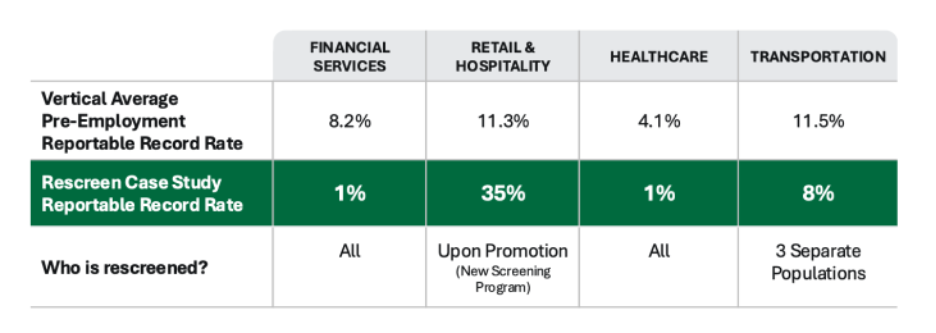
These results highlight the value rescreening can bring to employers, regardless of industry.
Key takeaway: Companies are increasingly recognising the importance of post-hire rescreening for overall risk management. Rescreening programs can be customised to employee roles and responsibilities, ensuring that searches are executed effectively to mitigate risks and support compliance.
Get Additional Insights to Transform Your Screening Program
Business practices recommend conducting a thorough annual review of your screening program. This review should consider the latest product enhancements, industry trends, and regulatory changes impacting your organisation.
Here’s a recap of the key trends from this year’s trends report:
- Fueled by technological advances, managing hiring risk has remained the top screening priority for customers in EMEA.
- Regulatory compliance is the main reason organisations in EMEA conduct background checks.
- Conducting identity checks in the hiring process enhances data reliability and helps combat identity fraud, and First Advantage supports it with a wide range of identity checks options tailored to regional and industry-specific needs.
- Despite the diversity of crimes and varying legal requirements, customers should continue to consider criminal record checks as part of their screening program,
- Post-employment rescreening allows employers to continually assess employee behaviour and respond appropriately.
Download the full report today:

Ready to transform your screening program to hire smarter and onboard faster? Get in touch with First Advantage.